House creates time for family

17 March 2011 kl 18:26

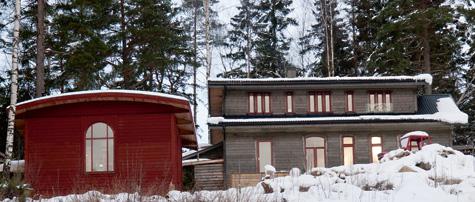
It is possible to create a better life for oneself in a way that also cuts costs and creates more time for family? Magnus Hjorth and Malin Wallinlind were successful at doing just this. The way there involved their own sawmill, salvage items, and dedicated effort.

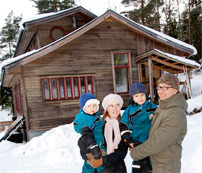
Magnus Hjorth and Malin Wallenlind with the kids Erik and Olof.
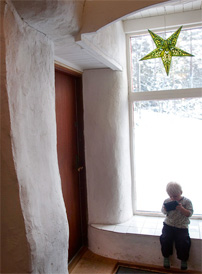
The columns in the entryway are made of mudded and whitewashed straw.
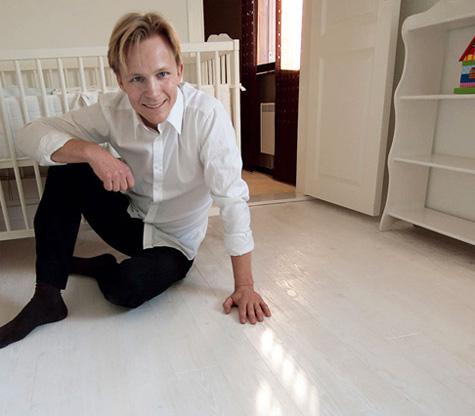
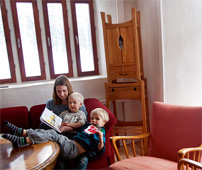
Malin Wallenlind and Magnus Hjorth won more time for themselves and their children Olof and Erik, thanks to low living costs. Even the corner cabinet is made of wood they cut themselves.
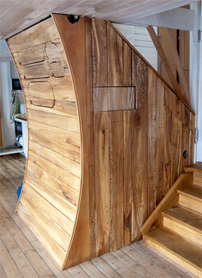
The accumulator tank is built into the kitchen, under the stairs to the second floor.

For Malin and Magnus the house is a part of their philosophy on life. Their basic premise is for living to be environmentally friendly; but even more important is the concept of having control over one's own life. It was a matter of getting out of the rat race and creating more time for their children.

Top of the hill
She and Magnus selected a lot that was at the top of a slope. The last part is pure slalom material. The advantage of this is a detached location with an incredible view over the valley and lake. The lot was a forest, and one of the first investments they made was therefore a sawmill, an electric Logosol M7.
Ecofriendly building now incorporates straw and clay. This was another method the couple selected, but not only for environmental reasons.
– It is the best method for those building their own homes, as it’s relatively simple to learn and forgiving of mistakes, explains Magnus.
The frame of the house is made of thick wooden posts. In principle, double layers are built with straightedges and between these, compressed bales of straw are stapled in. The straw is covered with a mixture of clay and cow manure. At first Magnus and Malin were reluctant to get into using manure, and they initially tried working without it.
– We quickly realised the cow manure was completely necessary. It makes everything adhere better and easier to work with, says Magnus.

Cold winter
He notes that the process of getting used to it is something like becoming a parent and changing diapers. Now that the house is done, you can’t smell any trace of the manure. On the outside, the clay is covered with a wooden panel that provides protection from the wind. The inside is whitewashed.
The entire building took two years to make,  the family moved in a year and a half ago. Their second winter was the coldest in living memory, and the house lived up to the challenge outstandingly. The thick straw walls provide ample insulation, and normally the heat generated by human inhabitants, electrical appliances and solar collectors is enough to keep the house warm.
The heart of the heating system is an accumulator tank charged by the solar panels. During the summer months this proves sufficient to heat both water and house. During the winter, a secondary fire is kept burning in a wooden stove connected to the tank.
The operating costs are extremely low. Water and waste are handled through a common purification system. Electrical consumption is around 3,000 kW a year. And the construction itself was record low. When Magnus last totalled up his receipts, the final cost was around SEK 380,000. This for 105 square metres of living space, plus secondary space and a workshop.
-The bank did not believe in the project. Instead we had to find alternative means of financing, through a saving and borrowing programme from JAK cooperative bank, says Magnus.

Re-used material
The interest-free JAK loan means that the house will be paid off in a few years. In combination with the inexpensive operations, this means that the family has avoided significant costs and can now budget in an entirely different way. They can work less and make themselves and their children a priority, without having to cut back.
-During construction I worked in home services and heard several people say they thought we had neither electricity nor running water. We have everything you’d find in an ordinary house, says Malin, pointing out the only new appliance in the house- a dishwasher.
Most of the building material and installations are recycled or we built them ourselves, or we bought them used, salvaged them, and so on. The result is a personalised home as far away from a standard cookie-cutter house as you can get.
A stone's throw from the entertainment metropolis of Blackpool on the English west coast, there is a man who lives for his chainsaws and a Logosol saw. His name is James Shelliker and made the switch to sculpting from his previous job as a park worker.

What is the best way to learn how to use a Logosol Sawmill?
     
“You watch Logosol’s films and start sawing,” is Kjell Rogström’s answer. He lives in the village Larsarvet just outside Falun in Sweden.

Ove Benjaminsson was one of the first to understand the possibilities of the Logosol Sawmill. He discovered it on the Swedish forestry exhibition Elmia in 1989. Two years later he bought his own sawmill at the same exhibition. The Logosol Sawmill is still in service.

The new Solo Planer/moulder SH410 is not a substitute for the reliable SH230.
It is the first in a new category of joinery machines.
The first machine you need, the first machine in the production flow.

Many people dream of making a living using machinery from Logosol.
Peter Andersson in Vreta Kloster, Östergötland, Sweden, has done just that.
"The important thing is not the machinery but the business concept and sales," he says.

Everyone who saws his or her own timber gets amazed by the same thing: Rough logs turning into smooth boards.
The designer Anton Alvarez captured the magical moment in a bench, which was shown during the London Design Week at the end of September.

Logosol was born in a demanding market and the unique demands they encountered have shaped this innovative company. Logosol is now partnering with an equally successful company in the US to extend their brand in the USA.

Jim Birkmeirer of Timbergreen Farm from Spring Green, Wisconsin recently contacted Logosol about a project he was working on with the Kallari Cooperative in Ecuador.

Recently we heard from one M7 owner who had collected a bunch of logs in anticipation of doing a lot of milling, only not to have time to mill up the logs until 2 years later. Rainer Kern called to tell us what he found when he cut into some hardwoods that had lain in place for several years. We discussed the value of spalted wood, and we sent him some reference material on this kind of wood to help him realize what he had found in these old logs. Here is his story:

Logosol continues to be on the move, designing innovative solutions for planning/moulding challenges.  When the PH360, Logosol’s largest four-sided planer/moulder, was first released, everyone noticed there was an extra button on the control panel of the PH360.  Some people utilized it to control the external chip extractor.   However, now the button’s real function is revealed, it’s to control an optional fifth cutter head.

The Bertilsson brothers outside Marma in Sweden, run a diversified business, to say the least of it.
Among other things, the offer sawing, planing, moulding and computer support.
“We are the modern village smithy, you could say,” says Harry, the oldest of the brothers.

All over Sweden traditional agriculture is being replaced by horse farms.
But a horse farm can be so much more than a place where you live with the horses.
Christian and Therese Sämberg have horses, but their plans are bigger than that.

It is wise to remove the trees that were felled by the strong winds this winter, otherwise there is a danger of insect infestation in the wood.
But how can you easily transport individual trees over logs and rocks?
Logosol has the solution, a smart log skidder trailer for four-wheelers.

In Sweden the trend is evident: Young people become more and more interested in crafts of the old times and dream of a life in the country.
Three of those are Johannes Kabell, Timothy Ohdin and Per Hansson.
They have started a crafts collective and are building a large workshop with the help of their jointly owned sawmill from Logosol.

Tormek’s grinding machines and their method for sharpening edge tools have a solid good reputation all over the world.
Here comes their top model in a bespoke version made for Logosol’s customers.

There are not days enough in the year for Anders Assarsson who runs Svenshult’s Sawmill south of Gothenburg on the Swedish west coast. Even though the largest model of Logosol-Låks frame saw is going at full speed and the neighbours are helping out.
Now, the frame saw is to be automated, with the help of a large circular saw.

”Slice up your storm-felled trees! It is done quickly and you preserve all the good qualities of the timber.” This advice comes from Logosol’s founder, Bengt-Olov Byström, who continues thinking small-scale after the hard winds of this winter.

800 million people live in and of the forest. Many are poor and would get a better life if their commodities and work were valued higher.
Part of a solution was presented this summer in a one thousand year old church ruin: doubly eco-labelled wooden flooring, produced in southern Chile with equipment from Logosol.

Boat building has ancient traditions. Lars Wigren belongs to the growing number that carries the traditions on with the help of an own sawmill.

The Logosol Sawmill M8 is the new model of the world’s most sold sawmill.
”We collected feedback from Logosol Sawmill owners all over the world,” says the product manager Mattias Byström at Logosol’s headquarters in Sweden.

Close