Milling Tropical Hardwood

20 January 2011 kl 10:00

Darrell Fox bought an Logosol M7 sawmill with an electric power head a few years back. At the time he was “locked into a job on Oahu,” and milling lumber was a good way to get back to what he really wanted to do in his off time – working with tropical hardwoods. In 2009, things changed dramatically for Darrell. His M7 became a part of a bigger organization, as did he. He writes us:

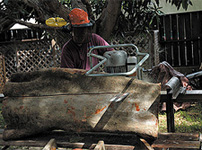
Darrell with M7 and electric powerhead cutting Koa log.
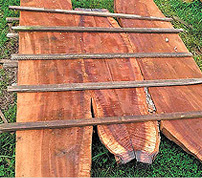
Koa boards stacked for drying.
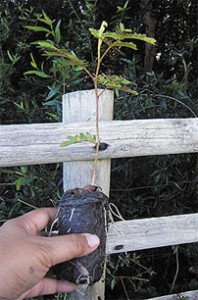
Eight week old koa seedling. ”We outplant at 10 weeks.”

“I started talking to my partner about the forestry idea and the more we talked the more it made sense as a business idea whose time had come… We had just struck a deal on the first 1000 acres of land suitable for growing koa.
Our forestry and nursery teams were in place and we had enough money in escrow to plant the first 50 acres– with more coming in every week. We were getting interest from every quarter. People liked the investment aspect, some were looking at the potential for carbon credits, some were interested in securing a lumber supply for their manufacturing businesses a few decades out, and some were just interested in going green.
In fact we are negotiating with a regional airline that wants to buy trees to offset their carbon footprint.”
Darrell’s partner, Jeff Dunster expands on what the company that Jeff and Darrell have started is doing. He says the M7 is now located at the project site and is still a part of the operation. “We use it to mill dead and fallen old growth trees on our property.”
However, Hawaiian Legacy Hardwoods, is about much more than milling lumber. This company is master planning a 2700 acre sustainable forestry project on Hawaii Island, growing rare tropical koa hardwood trees for investors all over the world. Reducing global warming through carbon sequestration and providing their investors the opportunity for substantial profits from lumber as well as the potential profit from the developing carbon credit market.
“In Hawaii, over 90% of the native forests have been lost to development and agriculture.
This pattern has been repeated all over the world. Last year the International Tropical Timber Organization predicted that at our current rate of clearing, we have less than 14 years of prized tropical hardwoods left to cut on the planet. At that point, the resource will either be completely depleted or in protected areas,” he stated.
“We all know what happens to the price of something when it becomes scarce. In the past ten years alone, we have seen the scarcity of Hawaiian koa lead to a price rise of more than 1000% and the situation is only getting worse. There is an ancient Chinese proverb which states the best time to plant a tree was 20 years ago— the second best time is now. Twenty years from now, there will be a lot of folks wishing it was 2010 again.”
HLH is making it where anyone can participate in this important work they are doing.
A visit to their website will show how critical it is to start this process of turning around tropical hardwood production.
“We are making it profitable for anyone to participate in growing tropical hardwoods here in Hawaii, no matter where they are located,” Jeff emphasized.
The company will work with individuals, corporations, IRAs and trusts to help them
become owners of tropical hardwoods that HLH will manage for them in their expanding tropical hardwood forestry operations.
“We believe a portfolio shouldn’t just be a vehicle for personal wealth, it’s should be a tangible expression of what an investor values most.”
The Logosol M7 will continue to be a part of the Hawaiian Legacy Hardwoods operation. But the future of Hawaiian hardwoods in this area is looking brighter thanks to the owners of this sawmill. You can help them with this project!
All over Sweden traditional agriculture is being replaced by horse farms.
But a horse farm can be so much more than a place where you live with the horses.
Christian and Therese Sämberg have horses, but their plans are bigger than that.

It is wise to remove the trees that were felled by the strong winds this winter, otherwise there is a danger of insect infestation in the wood.
But how can you easily transport individual trees over logs and rocks?
Logosol has the solution, a smart log skidder trailer for four-wheelers.

In Sweden the trend is evident: Young people become more and more interested in crafts of the old times and dream of a life in the country.
Three of those are Johannes Kabell, Timothy Ohdin and Per Hansson.
They have started a crafts collective and are building a large workshop with the help of their jointly owned sawmill from Logosol.

Tormek’s grinding machines and their method for sharpening edge tools have a solid good reputation all over the world.
Here comes their top model in a bespoke version made for Logosol’s customers.

There are not days enough in the year for Anders Assarsson who runs Svenshult’s Sawmill south of Gothenburg on the Swedish west coast. Even though the largest model of Logosol-Låks frame saw is going at full speed and the neighbours are helping out.
Now, the frame saw is to be automated, with the help of a large circular saw.

”Slice up your storm-felled trees! It is done quickly and you preserve all the good qualities of the timber.” This advice comes from Logosol’s founder, Bengt-Olov Byström, who continues thinking small-scale after the hard winds of this winter.

800 million people live in and of the forest. Many are poor and would get a better life if their commodities and work were valued higher.
Part of a solution was presented this summer in a one thousand year old church ruin: doubly eco-labelled wooden flooring, produced in southern Chile with equipment from Logosol.

Boat building has ancient traditions. Lars Wigren belongs to the growing number that carries the traditions on with the help of an own sawmill.

This year it is the tenth anniversary of the Logosol Sawmill model 7. 
Logosol celebrates this by taking the next step in development, the M8. But what happened on the way here?

The Logosol Sawmill M8 is the new model of the world’s most sold sawmill.
”We collected feedback from Logosol Sawmill owners all over the world,” says the product manager Mattias Byström at Logosol’s headquarters in Sweden.

For the first time in ten years, the wood-processing company Logosol presents a new Logosol Sawmill. The model passes under the name of M8 and includes a number of new modifications. Comfort and performance have been further raised. A new design gives the small sawyer more possibilities for both efficiency and job satisfaction.

Arne Larsson is a man of actions. He seldom regrets anything. Except when he a couple of years ago, cut up a large quantity of alder into firewood.
”Alder is the most beautiful sort of wood in the Swedish forests,” says Arne, who recently built a sauna, panelled with spalted and oiled alder.

What will a boat builder do when he cannot obtain mahogany that is wide enough? He takes his sawmill and goes to the woods.
”In the Swedish woods there are several interesting sorts of wood, like oak, elm and ash,” says Johan Nilsson, one of three boat builders behind the company Båthantverkarna (‘The Boat Craftsmen’ in English) in Stockholm.

Just in time for the planing season, Logosol introduces a completely new machine, which combines simplicity with larger size. To those who are already acquainted with the Logosol range of products this is a long-awaited big brother to the popular Logosol SH230, that was introduced more than ten years ago.

After investing in a sawmill the couple bought a Soloplaner. "A sawmill without a planer, it's like a computer without a printer," says Ronny Karlsson.

John Haag in Sweden has found his niche in small-scale wood processing. With his two sawmills he started a log home factory. His band sawmill can handle the rough logs, the portable sawmill runs the log house molder.

With his own sawmill, Gerard Saulnier can finally realize his dreams: making logs from the trees growing on the family estate.

Eight Laks saws turned a wrecked pine plantation into profitable forestry with record-low investment costs. The alternative would have been to burn down the whole forest plantation.

A new bimetallic blade with HSS teeth has been developed by Hakansson Sawblades. We visited the company and met CEO Olle Bergren for an interview.

The big challenge when it comes to industrial projects in developing countries is to find simple and durable equipment that give high productivity and quality.  Klas Bengtsson in Sweden has made this challenge his mission in life.

Close