From forest to timber house

14 June 2011 kl 08:40

Alister Lewis builds full timber houses according to customer requirements, right from the cutting of logs. He builds two houses a year, which is enough to keep his company going.
 "I've never advertised, yet I'm fully booked up," he says.

"The frame saw has been in operation for a maximum of 90 hours, long enough to cut all the timber for five houses," says Alister Lewis.

Chickens love sawdust.

Lewis is based in the county of Shropshire on the border of England and Wales. Despite the fact that the area was the cradle of the Industrial Revolution, it's now one of England's most rural counties. More and more people are moving here from London on the hunt for bargain country properties.
However, this wave of migration has had a negative impact on people living in the county as property prices have sky-rocketed. But Lewis saw a business opportunity in the problem: Renovating existing homes and building new ones precisely to the requirements of the new influx. It's all summed up in the name of his company - Bespoke.

Learned in the USA
Lewis lives on the family farm just outside the town of Ludlow and has established a wide network of contacts in the area with everyone from architects and structural engineers to forest owners. Essentially, he is an interiors carpenter and has also spent time working as a building carpenter in the USA.
"I was there for 18 months and learned to build timber frame houses. The technique is much more developed in the USA than here in the UK," says Lewis.
Traditionally, British houses are built from stone, brick or concrete.
"Timber framed houses have many advantages, not least in terms of their low energy consumption," says Lewis.

From forest to house
But instead of getting the tools out and starting to build timber houses, he developed a more far-reaching business concept that was based on an extensive reading about company financing. He came to the conclusion that the key to making his little company profitable was cutting out as many of the middle-men as possible and working in conjunction with collaboration partners to offer the entire chain of services from forest to finished house.
"I have good relationships with forest owners in the area and can buy timber that I finish myself," he says.
He was equally careful in his choice of sawmill equipment as he was in the development of his business concept. The aim was to spend as little time as possible in the sawmill and as much time as possible out on site.
"It isn't in the sawmill that I create the added value that customers are willing to pay more for," says Lewis.

Saws everything in four days
The result was a bandsaw mill and a 500 Plus Logosol Låks frame sawmill, the biggest in the range. It is a highly efficient and reliable combination.
"I cut all the timber for a house in four days; three days on the bandsaw to produce blocks and side pieces and one day on the frame saw," he says.
He started the sawmill 2½ years ago. In that time, he has completed five projects. All this means that the Låks saw is in almost new condition. Lewis estimates that it has run for a total of 90 hours.
"You can cut a lot of timber per hour with this sawmill," says Lewis.
The alternative to the frame sawmill would have been to employ or hire staff to produce the timber needed for a house. By using a bandsaw and doing everything himself, he has significantly reduced the value creation time spent on site.

Develop to perfection
Today, he brings in other small business owners during parts of the project, primarily architects and structural engineers, as well as carpenters for when the frame is erected. But the only point of contact customers need remember when they want a custom-built house is Alister Lewis.

All over Sweden traditional agriculture is being replaced by horse farms.
But a horse farm can be so much more than a place where you live with the horses.
Christian and Therese Sämberg have horses, but their plans are bigger than that.

It is wise to remove the trees that were felled by the strong winds this winter, otherwise there is a danger of insect infestation in the wood.
But how can you easily transport individual trees over logs and rocks?
Logosol has the solution, a smart log skidder trailer for four-wheelers.

In Sweden the trend is evident: Young people become more and more interested in crafts of the old times and dream of a life in the country.
Three of those are Johannes Kabell, Timothy Ohdin and Per Hansson.
They have started a crafts collective and are building a large workshop with the help of their jointly owned sawmill from Logosol.

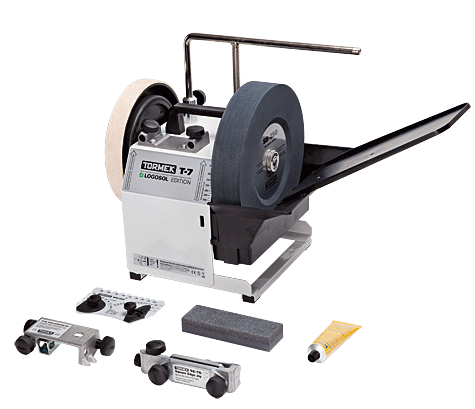
Tormek’s grinding machines and their method for sharpening edge tools have a solid good reputation all over the world.
Here comes their top model in a bespoke version made for Logosol’s customers.

There are not days enough in the year for Anders Assarsson who runs Svenshult’s Sawmill south of Gothenburg on the Swedish west coast. Even though the largest model of Logosol-Låks frame saw is going at full speed and the neighbours are helping out.
Now, the frame saw is to be automated, with the help of a large circular saw.

”Slice up your storm-felled trees! It is done quickly and you preserve all the good qualities of the timber.” This advice comes from Logosol’s founder, Bengt-Olov Byström, who continues thinking small-scale after the hard winds of this winter.

800 million people live in and of the forest. Many are poor and would get a better life if their commodities and work were valued higher.
Part of a solution was presented this summer in a one thousand year old church ruin: doubly eco-labelled wooden flooring, produced in southern Chile with equipment from Logosol.

Boat building has ancient traditions. Lars Wigren belongs to the growing number that carries the traditions on with the help of an own sawmill.

This year it is the tenth anniversary of the Logosol Sawmill model 7. 
Logosol celebrates this by taking the next step in development, the M8. But what happened on the way here?

The Logosol Sawmill M8 is the new model of the world’s most sold sawmill.
”We collected feedback from Logosol Sawmill owners all over the world,” says the product manager Mattias Byström at Logosol’s headquarters in Sweden.

For the first time in ten years, the wood-processing company Logosol presents a new Logosol Sawmill. The model passes under the name of M8 and includes a number of new modifications. Comfort and performance have been further raised. A new design gives the small sawyer more possibilities for both efficiency and job satisfaction.

Arne Larsson is a man of actions. He seldom regrets anything. Except when he a couple of years ago, cut up a large quantity of alder into firewood.
”Alder is the most beautiful sort of wood in the Swedish forests,” says Arne, who recently built a sauna, panelled with spalted and oiled alder.

What will a boat builder do when he cannot obtain mahogany that is wide enough? He takes his sawmill and goes to the woods.
”In the Swedish woods there are several interesting sorts of wood, like oak, elm and ash,” says Johan Nilsson, one of three boat builders behind the company Båthantverkarna (‘The Boat Craftsmen’ in English) in Stockholm.

Just in time for the planing season, Logosol introduces a completely new machine, which combines simplicity with larger size. To those who are already acquainted with the Logosol range of products this is a long-awaited big brother to the popular Logosol SH230, that was introduced more than ten years ago.

After investing in a sawmill the couple bought a Soloplaner. "A sawmill without a planer, it's like a computer without a printer," says Ronny Karlsson.

John Haag in Sweden has found his niche in small-scale wood processing. With his two sawmills he started a log home factory. His band sawmill can handle the rough logs, the portable sawmill runs the log house molder.

With his own sawmill, Gerard Saulnier can finally realize his dreams: making logs from the trees growing on the family estate.

Eight Laks saws turned a wrecked pine plantation into profitable forestry with record-low investment costs. The alternative would have been to burn down the whole forest plantation.

A new bimetallic blade with HSS teeth has been developed by Hakansson Sawblades. We visited the company and met CEO Olle Bergren for an interview.

The big challenge when it comes to industrial projects in developing countries is to find simple and durable equipment that give high productivity and quality.  Klas Bengtsson in Sweden has made this challenge his mission in life.

Close