Portable sawmill in family forest

4 May 2011 kl 09:22

Buying a woodland property in the popular English Lake District should be an impossibility. After all, it’s one of the UK’s most visited tourist destinations.
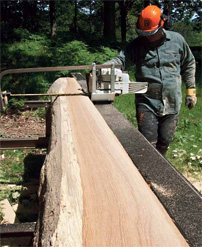
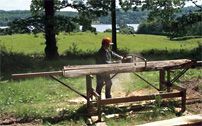
”Jane comes from the area and our neighbours are all her relations,” says John Cushnie, lifting an oak log onto his portable sawmill.


Family sawmill.
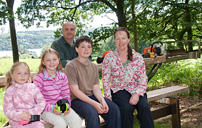
The forest is a family project to which daughters Lucie and Alice are almost as committed as their dad John.
Behind a sawing John Cushnie you can see Lake Windermere, the biggest inland body of water in the UK.
The bark of this oak hides timber of furniture quality.

John Cushnie with his portable sawmill.

Jane is his wife and the couple have three children - Callum aged 11, Alice aged 9 and Lucie aged 4. The family live in a small town, 40 minutes drive from the forest they own. This, in turn, lies on the shore of Lake Windermere, the biggest lake in the UK and at the heart of the Lake District.
On the other side of the lake is the village of Windermere. Picturesque, but also a tourist trap with innumerable hotels and guest houses. However, the forest has the peace and tranquillity the Cushnie family were after when they got the opportunity to purchase the property in 2003.

Better finish yourself
”I’m a qualified engineer,” says John, who currently works for a mobile telephone company.
For him, the forest is not only an opportunity for relaxation. The engineer in him also sees an opportunity to improve and create. That’s why a few years ago he bought a Logosol M7 to deal with storm damaged and thinned out trees.
”The property is far too small to make it economically viable to bring in a contractor.
It’s better we take care of the trees ourselves,” says John.

Plans for the future
The forest and sawmill are currently just a hobby and a source of timber for the use of family and friends, and has supplied one relative with ash that they use to repair classic cars.
In the long term, the forest will become part of the family’s source of income. The idea is to build a few overnight cabins close by and run courses associated with the forest.
Interest in nature and forests is on the increase in the UK. One example of this is the rapid growth in wood burning stoves.
”There’s a major need to learn how to use a chainsaw,” says John as one example of potential future courses.
All over Sweden traditional agriculture is being replaced by horse farms.
But a horse farm can be so much more than a place where you live with the horses.
Christian and Therese Sämberg have horses, but their plans are bigger than that.

It is wise to remove the trees that were felled by the strong winds this winter, otherwise there is a danger of insect infestation in the wood.
But how can you easily transport individual trees over logs and rocks?
Logosol has the solution, a smart log skidder trailer for four-wheelers.

In Sweden the trend is evident: Young people become more and more interested in crafts of the old times and dream of a life in the country.
Three of those are Johannes Kabell, Timothy Ohdin and Per Hansson.
They have started a crafts collective and are building a large workshop with the help of their jointly owned sawmill from Logosol.

Tormek’s grinding machines and their method for sharpening edge tools have a solid good reputation all over the world.
Here comes their top model in a bespoke version made for Logosol’s customers.

There are not days enough in the year for Anders Assarsson who runs Svenshult’s Sawmill south of Gothenburg on the Swedish west coast. Even though the largest model of Logosol-Låks frame saw is going at full speed and the neighbours are helping out.
Now, the frame saw is to be automated, with the help of a large circular saw.

”Slice up your storm-felled trees! It is done quickly and you preserve all the good qualities of the timber.” This advice comes from Logosol’s founder, Bengt-Olov Byström, who continues thinking small-scale after the hard winds of this winter.

800 million people live in and of the forest. Many are poor and would get a better life if their commodities and work were valued higher.
Part of a solution was presented this summer in a one thousand year old church ruin: doubly eco-labelled wooden flooring, produced in southern Chile with equipment from Logosol.

Boat building has ancient traditions. Lars Wigren belongs to the growing number that carries the traditions on with the help of an own sawmill.

This year it is the tenth anniversary of the Logosol Sawmill model 7. 
Logosol celebrates this by taking the next step in development, the M8. But what happened on the way here?

The Logosol Sawmill M8 is the new model of the world’s most sold sawmill.
”We collected feedback from Logosol Sawmill owners all over the world,” says the product manager Mattias Byström at Logosol’s headquarters in Sweden.

For the first time in ten years, the wood-processing company Logosol presents a new Logosol Sawmill. The model passes under the name of M8 and includes a number of new modifications. Comfort and performance have been further raised. A new design gives the small sawyer more possibilities for both efficiency and job satisfaction.

Arne Larsson is a man of actions. He seldom regrets anything. Except when he a couple of years ago, cut up a large quantity of alder into firewood.
”Alder is the most beautiful sort of wood in the Swedish forests,” says Arne, who recently built a sauna, panelled with spalted and oiled alder.

What will a boat builder do when he cannot obtain mahogany that is wide enough? He takes his sawmill and goes to the woods.
”In the Swedish woods there are several interesting sorts of wood, like oak, elm and ash,” says Johan Nilsson, one of three boat builders behind the company Båthantverkarna (‘The Boat Craftsmen’ in English) in Stockholm.

Just in time for the planing season, Logosol introduces a completely new machine, which combines simplicity with larger size. To those who are already acquainted with the Logosol range of products this is a long-awaited big brother to the popular Logosol SH230, that was introduced more than ten years ago.

After investing in a sawmill the couple bought a Soloplaner. "A sawmill without a planer, it's like a computer without a printer," says Ronny Karlsson.

John Haag in Sweden has found his niche in small-scale wood processing. With his two sawmills he started a log home factory. His band sawmill can handle the rough logs, the portable sawmill runs the log house molder.

With his own sawmill, Gerard Saulnier can finally realize his dreams: making logs from the trees growing on the family estate.

Eight Laks saws turned a wrecked pine plantation into profitable forestry with record-low investment costs. The alternative would have been to burn down the whole forest plantation.

A new bimetallic blade with HSS teeth has been developed by Hakansson Sawblades. We visited the company and met CEO Olle Bergren for an interview.

The big challenge when it comes to industrial projects in developing countries is to find simple and durable equipment that give high productivity and quality.  Klas Bengtsson in Sweden has made this challenge his mission in life.

Close